WORKOUT OF THE DAY

3-27-12

Skill:

Muscle-up practice (15 mins)

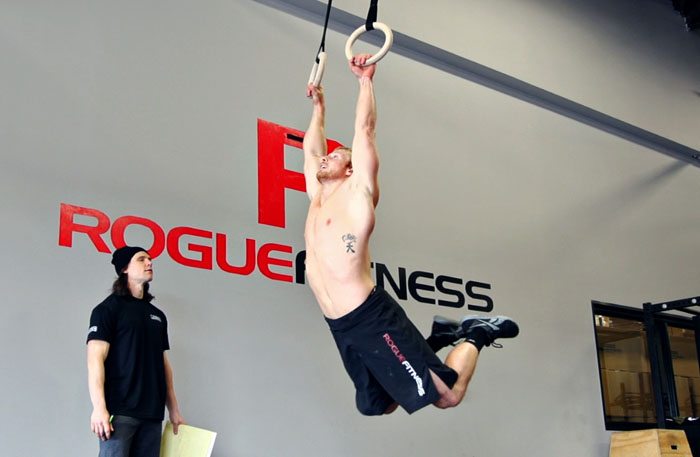
Practice for muscle-ups can be done many different ways.  One can use the rings on the pull-up rack to practice on ring rows, ring dips and transitioning from the pull to the dip.  OR, one can use the hanging wooden rings to practice actual muscle-ups.  Use your current skill level to determine where you want to focus your efforts for 15 mins.  I will be able to give general feedback to everyone during the practice, but won’t have one-on-one time to ensure that you are doing it 100% accurately. Gymnastic skill movements require a great deal of practice and kinesthetic awareness to become proficient in.  HOMEWORK and PRACTICE will pay off in the future.

WOD:

“Annie”

50-40-30-20-10 of:

Double-unders

Sit-ups

5
3-26-12

Strength:

Squat Clean, 3-3-3-3-3

Conditioning:

Using 50% of your last round of 3 from your squat clean, complete the following:

21-15-9 reps of:

Front Squat

Kettlebell swing, 2 pood

The Squat Clean from Again Faster on Vimeo.

3-23-12

3-23-12

CrossFit Games Open 12.5

Complete as many reps as possible in 7 minutes of the following rep scheme:

3 Thrusters, 100/65
3 Chest to bar Pull-ups

6 Thrusters, 100/65
6 Chest to bar Pull-ups

9 Thrusters, 100/65
9 Chest to bar Pull-ups

12 Thrusters, 100/65
12 Chest to bar Pull-ups

15 Thrusters, 100/65
15 Chest to bar Pull-ups

18 Thrusters, 100/65
18 Chest to bar Pull-ups…

This is a timed workout. If you complete the round of 18, go on to 21. If you complete 21, go on to 24, etc.

Standards of Movement:

Thruster

This is a standard barbell thruster in which the barbell moves from the bottom of a front squat to full lock out overhead. The bar starts on the ground. No racks allowed. The hip crease must pass below the knees. A full squat clean into the thruster is allowed if the bar is on the ground. The barbell must come to full lockout overhead with the hips, knees and arms fully extended, and the bar directly over the heels.

Chest-to-bar Pull-up

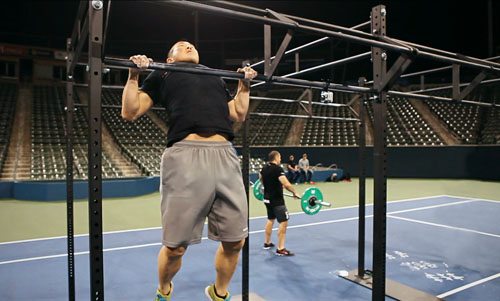
This is a standard chest to bar pull-up. Dead-hang, kipping or butterfly pull-ups are all allowed as long as all the requirements are met. The arms must be fully extended at the bottom. At the top, the chest must clearly come into contact with the bar.

3-22-12

5 rounds for time of:

11 Hang Power Clean

11 Push Ups (hand-release)

11 V-Ups

3-21-12

3-21-12

Complete for max reps (calories) per round

Tabata Row

Tabata Plank Hold

Tabata Burpee

Tabata Hollow Rock

What is a Tabata and how is it performed?

A Tabata Interval (also called a Tabata sequence) is an interval training cycle of 20 seconds of maximum intensity exercise, followed by 10 seconds of rest, repeated without pause 8 times for a total of four minutes. In a group context, you can keep score by counting how many lifts/jumps/whatever you do in each of the 20 second rounds. Usually, the round with the smallest number is your score. You can also count total reps completed over the whole sequence.

History of the Tabata Interval

Credit for this simple and powerful training method belongs to its namesake, Dr. Izumi Tabata and a team of researchers from the National Institute of Fitness and Sports in Tokyo, Japan. Their groundbreaking 1996 study, published in the journal Medicine and Science in Sports & Exercise, provided documented evidence concerning the dramatic physiological benefits of high-intensity intermittent training. After just 6 weeks of testing, Dr. Tabata noted a 28% increase in anaerobic capacity in his subjects, along with a 14% increase in their ability to consume oxygen (V02Max). These results were witnessed in already physically fit athletes. The conclusion was that just four minutes of Tabata interval training could do more to boost aerobic and anaerobic capacity than an hour of endurance exercise.
Although Dr. Tabata used a mechanically braked exercise cycle machine, you can apply this protocol to almost any exercise. For example, a basic Tabata workout can be performed with sit-ups. The more muscles used the better, so use full knees-bent sit-ups. Sit-up non-stop for 20-second intervals, followed by 10 seconds of rest. Repeat for a total of 8 cycles.

3-20-12

Strength:

Snatch, 3-3-3-3-3

Conditioning:

21-15-9

Deadlift, 225/155

Box Jump, 24/20

3-19-12

“Helen”

Complete 3 rounds for time of:

Run 400m

21 Kettlebell swings, 53/35

12 Pull ups

3-16-12

3-16-12

WORKOUT 12 . 4

Complete as many rounds and reps as possible in 12 minutes of:

150 Wall balls (M-20lbs to 10′ target) (W-14lbs to 9′ target)
90 Double-unders
30 Muscle-ups

Wall Ball

In the wall ball, the medicine ball must be taken from the bottom of a squat, hip crease below knee, and thrown to hit the specified target.The center of the ball must hit the target at or above the specified target height. If the ball hits low or does not hit the wall it is no rep.

Double-under

This is a standard double-under in which the rope passes twice for each jump. Only successful jumps are counted, not just attempts.

Muscle-up

In the muscle-up you must pass from a hang below the rings to support above them. A kipping muscle-up is ok, swings or rolls to support are not permitted.The arms must come to a full lock out (with or without a “false grip”) with the feet off the ground. The elbows must fully lock out while supporting yourself above the rings..

3-15-12

Strength:

Deadlift, 5-5-5-5-5

WOD:

Complete AMRAP in 10 mins of:

Sprint 100 m

20 Kettlebell Swings, 53/35

15 Ring Rows


Cool Down (10 mins minimum)…Double Under Practice & Foam Roller–Stretch-Stretch-Stretch

3-14-12

3-14-12

Complete for time:

Run 800

21-15-9 reps of:

Push-ups

Sit-ups

Squats

Run 800